- The Book of Lord Shang: was a work by Gongson Yang, chief counselor of Qin, who built the Qin's bureaucratic system in the 4th century b.c.e. He believed in rule by law, not by men. It states “The way to administer a state well is for the laws regulating officials to be clear; one does not rely on men to be intelligent and thoughtful. The ruler makes the people single-minded so they will not scheme for selfish profit. Then the strength of the state will be consolidated, and a state who strength has been consolidated is powerful, but a country that loves talking is dismembered.”

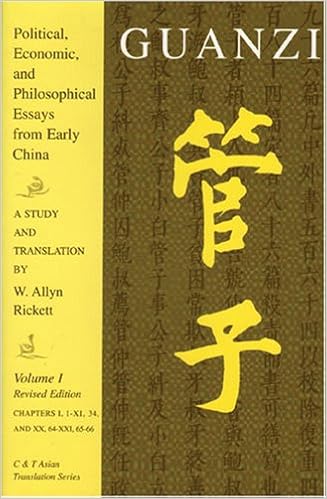
- Guanzi: philosophically characterize Legalism, other sections blend doctrines from Confucianism and Taoism. For example, the Nèiyè chapter has some of the oldest recorded descriptions of Daoist meditation techniques. There are also essays on a wide variety of other subjects, ranging from detailed economic discussions to overviews of local soil topography. Such divergence resulted in the changing affiliation of the text in the ancient library lists: it has been characterized as Legalist since Sui dynasty (581-617), while before that it was listed as Taoist.
When you enlarge your mind and let go of it,
When you relax your [qi] vital breath and
expand it,
When your body is calm and unmoving:
And you can maintain the One and discard
the myriad disturbances.
You will see profit and not be enticed by
it,
You will see harm and not be frightened
by it.
Relaxed and unwound, yet acutely
sensitive,
In solitude you delight in your own
person.
This is called "revolving the vital
breath":
Your thoughts and deeds seem heavenly.
- Han Feizi: "If somebody in this present age should praise the ways of Yao and Shun … he would certainly be ridiculed by contemporary [Legalist] sages. Hence the sage does not seek to follow the ways of the ancients, nor does he regard precedents as the rule. He examines the circumstances of his own time and plans his course of action accordingly. There was once a man of Sung who tilled his field. In the midst of his field stood the stump of a tree, and one day a hare, running at full speed, bumped into the stump, broke its neck, and died. Thereupon the man left his plow and kept watch at the stump, hoping that he would get another hare. But he never caught another hare, and was only ridiculed by the people of Sung. Now those who try to rule the people of the present age with the conduct of government of the early kings are all doing exactly the same thing as that fellow who kept watch by the stump."

- Sunzi’s Art of War: systematic guide to the strategy and tactics of how to defeat one's enemy decisively. Sunzi says the ‘supreme act of war is to subdue the enemy without fighting’ – meaning that conquest is best achieved through superior intelligence, attacking the other side's strategy rather than making a potentially costly full frontal attack. It stresses the importance of accurate information about one's own capabilities, about the opponent's forces, and the battle terrain (‘know the enemy and know yourself’), in order to remove the enemy from a state of harmony to one of chaos.
